Bake chewy plain bagels if you have bread flour and instant yeast
Key Takeaway
With bread flour, instant yeast, and lukewarm water, you can bake eight delightfully chewy homemade plain bagels in just 20 to 25 minutes in a 218°C oven.
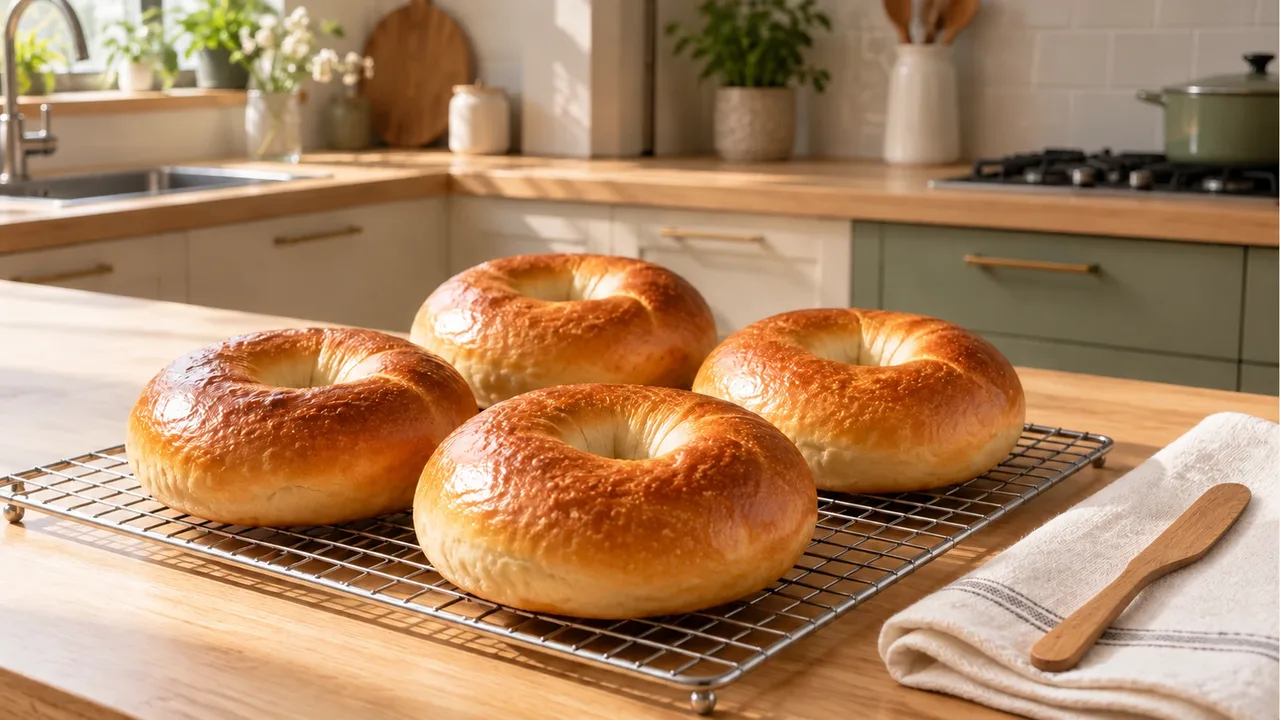
Boiling the shaped dough in hot water right before baking creates the glossy, taut skin and uniquely dense, satisfying crumb of traditional bagels. Below are the ingredients and measurements, water bath boiling details, oven settings, preparation steps, and key tips to avoid mistakes.
What can you bake with bread flour and instant yeast?
Plain bagels are a quintessential breakfast bread containing minimal fat or butter, allowing the natural, nutty flavor of fermented wheat to shine. Developing a tight gluten matrix with high-protein bread flour gives the crumb a dense, elastic chewiness that holds up wonderfully when sliced and toasted.
They pair effortlessly with cream cheese, fruit preserves, or savory sandwich fillings like smoked salmon and sliced vegetables. Unlike standard sandwich loaves, dropping the shaped dough into boiling water briefly gelatinizes the surface starches, producing the thin, delightfully chewy crust that defines authentic bagels.
What ingredients and measurements do I need?
Measuring units: T means one level Korean table spoon (about 15 ml), and t means one teaspoon (about 5 ml).
| Ingredient | Amount | Preparation |
|---|---|---|
| Bread flour | 540 g | Sifted to eliminate lumps |
| Lukewarm water | 355 g | Comfortable to the touch (about 38 to 40°C) |
| Instant yeast | 2 t (about 6 g) | |
| Brown sugar | 2 T (about 30 g) | Honey or barley malt syrup can be used instead |
| Fine salt | 1 T (about 14 g) | |
| Vegetable oil | 1 t (about 5 g) | For greasing the proofing bowl |
| Water for boiling | 2 L (2000 ml) | Brought to a gentle simmer in a wide pot |
| Sugar for boiling | 2 T (about 30 g) | Dissolved into the boiling water |
Using strong bread flour is essential for establishing the chewy bite that characterizes a true bagel. Low-protein pastry or cake flour will yield a soft, bread-roll texture rather than a sturdy bagel crumb, so opt for flour with high gluten potential.
Why should you boil bagel dough in water before baking?
The defining characteristic that sets bagels apart from other breads is the hot water bath immediately prior to baking. Immersing the proofed dough in simmering water deactivates yeast activity at the surface while rapidly gelatinizing the outer starch layer into a thin, protective barrier.
This gelatinized starch skin traps internal steam and moisture during baking, preventing the bagels from blowing out unevenly while keeping the interior moist and chewy. Adding two tablespoons of sugar or honey to the boiling water encourages deep golden browning and imparts a faint shine to the baked crust.
What temperature and how long should I bake them?
| Oven temperature | Baking time | How to tell it is done |
|---|---|---|
| 218°C (425°F), preheated oven | 20 to 25 minutes | The crust turns deep golden brown and sounds hollow when tapped on the bottom |
Baking at a hot 218°C is necessary to crisp the exterior while ensuring the dense center bakes through completely. Check the bagels at the 20-minute mark; when the undersides show uniform caramelization, remove the baking sheet from the oven.
What steps should I follow?
- In a large mixing bowl, combine 355 g lukewarm water, 2 T (about 30 g) brown sugar, and 2 t (about 6 g) instant yeast, stirring gently with a spatula until dissolved.
- Sift in 540 g bread flour and 1 T (about 14 g) fine salt. Mix until a shaggy dough forms, then turn out onto a clean work surface and knead vigorously by hand for 10 minutes until elastic.
- Shape the smooth dough into a ball and place it in a bowl lightly coated with 1 t (about 5 g) vegetable oil. Cover with plastic wrap and let it rise in a warm spot (about 26 to 28°C) for 60 minutes until doubled in bulk.
- Gently punch down the risen dough to deflate excess gas. Divide evenly into 8 portions (approximately 110 to 115 g each), round into smooth balls, cover with a damp kitchen towel, and rest for 10 minutes.
- Form each ball into a ring by pushing your thumb through the center and rotating your fingers to widen the central hole to about 4 to 5 cm in diameter, then set on a parchment-lined baking sheet.
- Bring 2 L water and 2 T (about 30 g) sugar to a rolling boil in a wide pot, then lower to a gentle simmer. Gently drop the bagels in and boil for 1 minute per side, then lift out with a slotted spoon and drain thoroughly.
- Transfer the boiled bagels back to the baking sheet and bake in the preheated 218°C oven for 20 to 25 minutes. Once the crusts are deeply browned and set, remove and cool on a wire rack for 30 minutes before serving.
What should I keep in mind to prevent mistakes?
- Ensure the water used for mixing is not too hot, as temperatures above 45°C can kill the yeast. Aim for a comfortable 38 to 40°C.
- Do not boil the dough for more than 1 minute per side. Over-boiling toughens the crust excessively and impedes oven spring, resulting in a rubbery texture.
- Stretch the center hole generously to 4 or 5 cm during shaping. The dough expands substantially in the boiling water and the oven, which will close up smaller openings entirely.
- Drain boiled bagels well on a clean rack or slotted spoon before placing them on parchment paper so the bottoms do not become soggy and adhere to the paper.
- Never taste or consume raw dough containing unbaked flour, and wash hands and work surfaces thoroughly with soap. Exercise caution if you have wheat allergies.
Frequently Asked Questions
Will bagels bake up crisp and chewy even without a steam-injected oven?
Because the dough is boiled in a water bath immediately before entering the oven, bagels achieve their signature taut, crisp exterior and dense, chewy interior in standard home ovens without steam functions.
Can I substitute active dry yeast for instant yeast?
When using active dry yeast, dissolve it in 50 g of the recipe's lukewarm water along with 1 tablespoon of sugar and let it proof for 5 to 10 minutes until foamy before blending it into the flour mixture.
How should I store leftover bagels?
Once cooled completely on a wire rack, keep them in an airtight container at room temperature for up to two days. For longer storage, slice each bagel in half, wrap securely in plastic wrap, and freeze.
Sources & Verification Date
- Plain bagel recipe and water bath boiling instructions · Verified
- Homemade bagel dough and baking reference · Verified
All materials have been verified from official announcements and may have changed since verification.