Warm Your Eggs in Hot Water When a Recipe Calls for Room Temperature
Key Takeaway
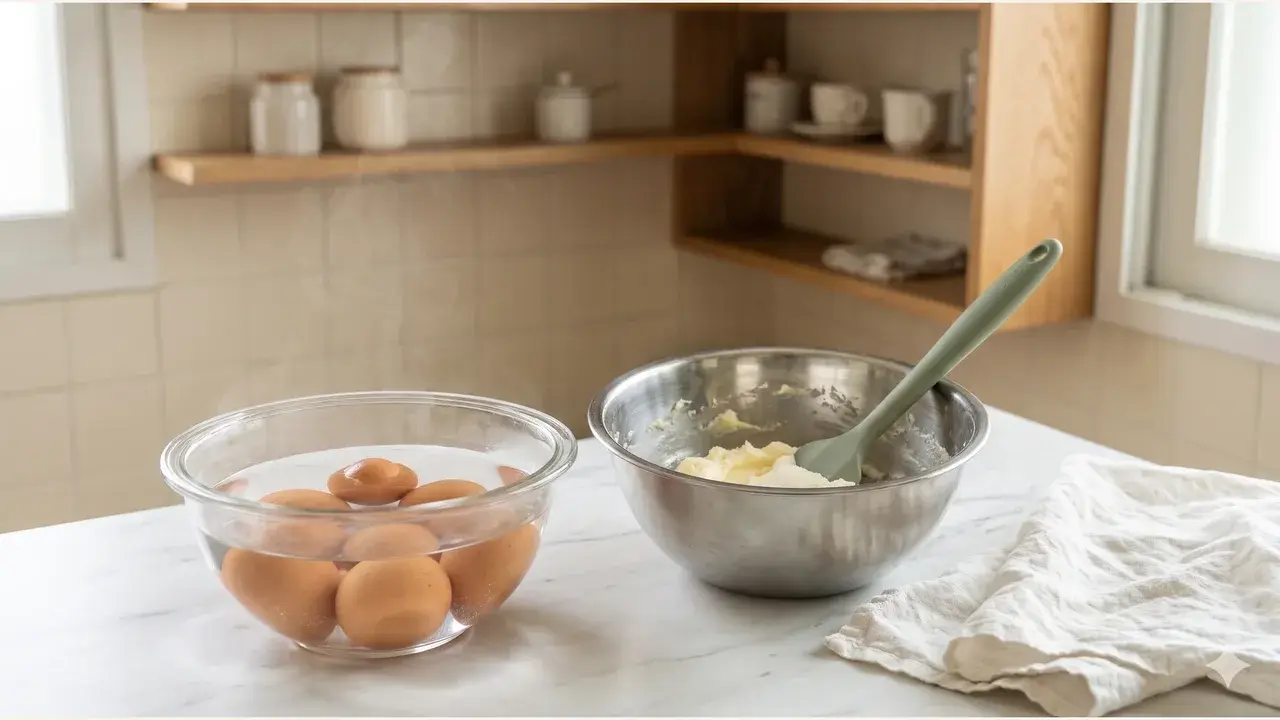
For room-temperature eggs, soak cold eggs in their shells in hot water (not boiling) for about 10 minutes, until close to 70°F (about 21°C). If the recipe gives no temperature, cold eggs are usually fine.
Which batters change with egg temperature?
It depends on what the eggs do in the batter. If you beat butter and sugar to trap air, cold eggs stiffen the butter again and the air escapes. The cake rises less and the crumb turns coarse.
| Batter | Egg temperature | Why |
|---|---|---|
| Cake made by creaming butter and sugar | Room temperature | Cold eggs firm up the butter and collapse the air bubbles |
| Cheesecake | Room temperature | The cream cheese stiffens again, forms lumps and needs longer beating |
| Creamed muffins and cookies | Room temperature if the recipe says so | Muffins can come out low and coarse, and cookies hard and flat |
| Yeast bread with a lot of egg | Room temperature | Cold eggs slow the yeast and lengthen the rise |
| Stir-together cakes, bars, muffins and cookies | Cold is fine | The eggs add fat and structure rather than air |
| Whites for meringue or buttercream | Separate cold, then bring to room temperature | Warmer whites hold more air |
Checked on October 23, 2026. The room-temperature range is 68–70°F (about 20–21°C). "A lot of egg" means more than 1 large egg per cup of flour. Brioche, with its very buttery dough, is the exception because cold eggs help firm it up. Eggs baked on top of a pizza or bread hold their shape better straight from the fridge.
How do you bring eggs to room temperature?
Fill a large bowl with hot water. Think warm bath rather than scalding shower, and do not use boiling water.
- Check the shells for cracks first.
- Submerge the cold eggs in their shells.
- After about 10 minutes they reach close to 70°F (about 21°C).
- Crack them in right away, following the recipe's order.
If you fill the bowl and add the eggs before you cream the butter and sugar, they are ready when the batter is. For a recipe that uses whites on their own, separate the eggs while they are cold and then warm only the whites.
How long can eggs stay out of the fridge?
The FDA says to put eggs in a refrigerator at 40°F (about 4°C) or below as soon as you buy them, keep them in the original carton and use them within 3 weeks for quality. It also says to check the temperature with a refrigerator thermometer.
There is a time limit at room temperature too. King Arthur cites the FDA in advising no more than 2 hours, or 1 hour in warmer conditions. The FDA's own page says to leave cooked eggs and egg dishes out for no more than 2 hours, and 1 hour above 90°F (about 32°C).
What should you check before you bake?
Find how the recipe lists the eggs. If it says room temperature, use the method above. If it gives no temperature, start with cold eggs. If you have an egg allergy, check the ingredient list and the labels on the products you use.
Bake egg-containing batter for the time and doneness check the recipe gives, until it is cooked through. If a creamed butter batter looks curdled after cold eggs go in, the result can change even with the same formula, so next time put the eggs in warm water first.
Frequently Asked Questions
Can I leave eggs out overnight to reach room temperature?
It is not recommended. The FDA says to keep eggs refrigerated at 40°F (about 4°C) or below, and King Arthur cites the FDA in advising no more than 2 hours at room temperature. Use hot water to warm them within that limit.
Will cold eggs make my muffins fail?
Creamed muffins can rise lower and turn out coarser. If the recipe says room-temperature eggs, follow it. If it gives no temperature, cold eggs are usually fine.
Will the hot water cook the eggs?
Use hot water, not boiling, closer to a warm bath than a scalding shower. The source gives no exact water temperature. Do not soak cracked eggs, and choose eggs without cracks when you buy them.
Sources & Verification Date
- Explanation of whether eggs used in baking really need to be at room temperature · Verified
- U.S. Food and Drug Administration egg safety guidance · Verified
All materials have been verified from official announcements and may have changed since verification.